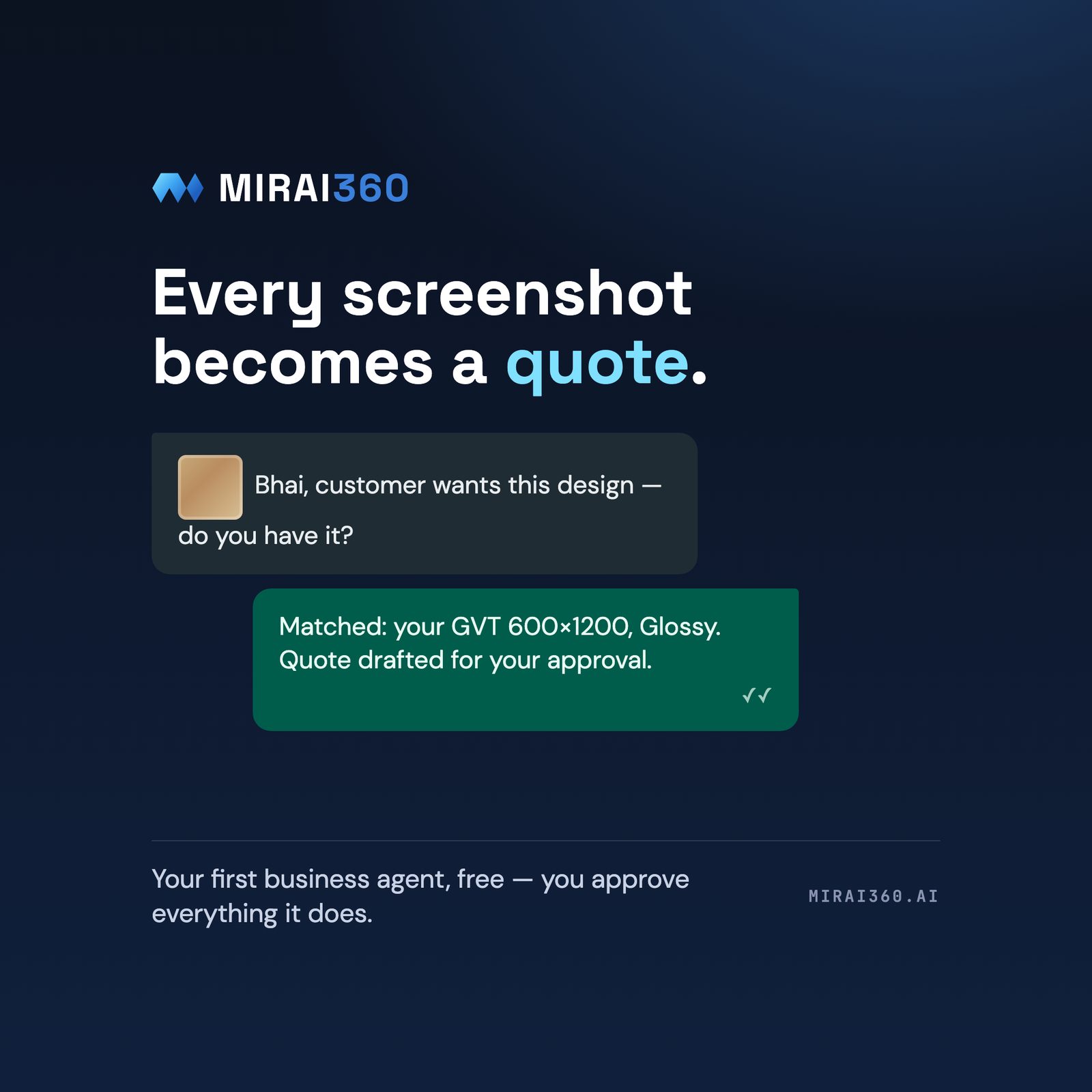
For most small and mid-size businesses in India, WhatsApp is not a marketing channel — it is where the business actually happens. A customer sends a photo and asks for a price. A dealer asks where an order is. A quote goes quiet and needs a nudge. Someone on the team reads each message, checks the real data, and types a reply, one conversation at a time.
"WhatsApp automation for business" usually gets pitched as a chatbot: a script that answers FAQs and collects a lead. Mirai360 AI is not that. It is an AI layer for the business — one specific workflow at a time, connected to the business's own catalogue, order system, or CRM — that happens to talk to the business and its customers through WhatsApp, because that is where the conversation already happens. WhatsApp is the door; the AI layer, and a named person's approval, decide what goes out.
What does WhatsApp automation for a business actually mean?
It means an agent that reads an incoming WhatsApp message, checks it against the business's own data — a catalogue, a price list, an ERP order record, a CRM pipeline — and drafts a reply in the business's own words. Not a chatbot that talks; an agent that does one piece of the work a person currently does by hand, then hands the draft to a person before anything reaches the customer. WhatsApp is where the message arrives and where the reply goes out — the reading, checking, and drafting happen in one system behind it, the same system that can show the owner a dashboard view of what happened, not a second, disconnected tool.
Photo in, quote out
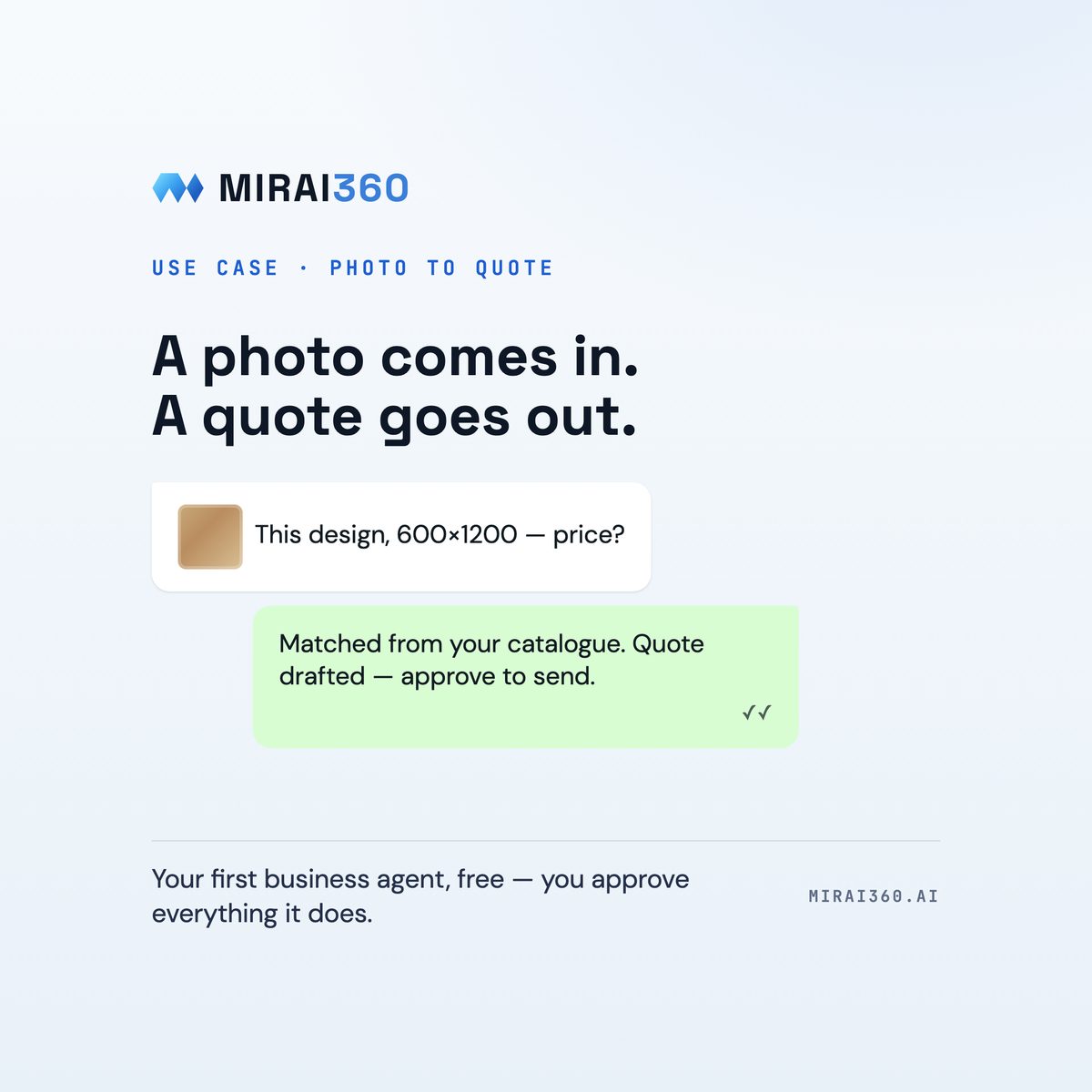
A common first workflow: a customer or dealer sends a photo on WhatsApp — sometimes a screenshot from a competitor's site — and asks for the same item: what size, what spec, what it costs. Mirai360 built exactly this agent for a Gujarat tile manufacturer: it reads the incoming image against the manufacturer's own catalogue and proposes the closest match, along with the applicable price from the manufacturer's own pricing rules (full case: AI Agents for Tile Manufacturers: From WhatsApp Photo to Quote). The draft goes to a named person for review before it goes back to the customer.
Order status and dispatch updates, answered from real data
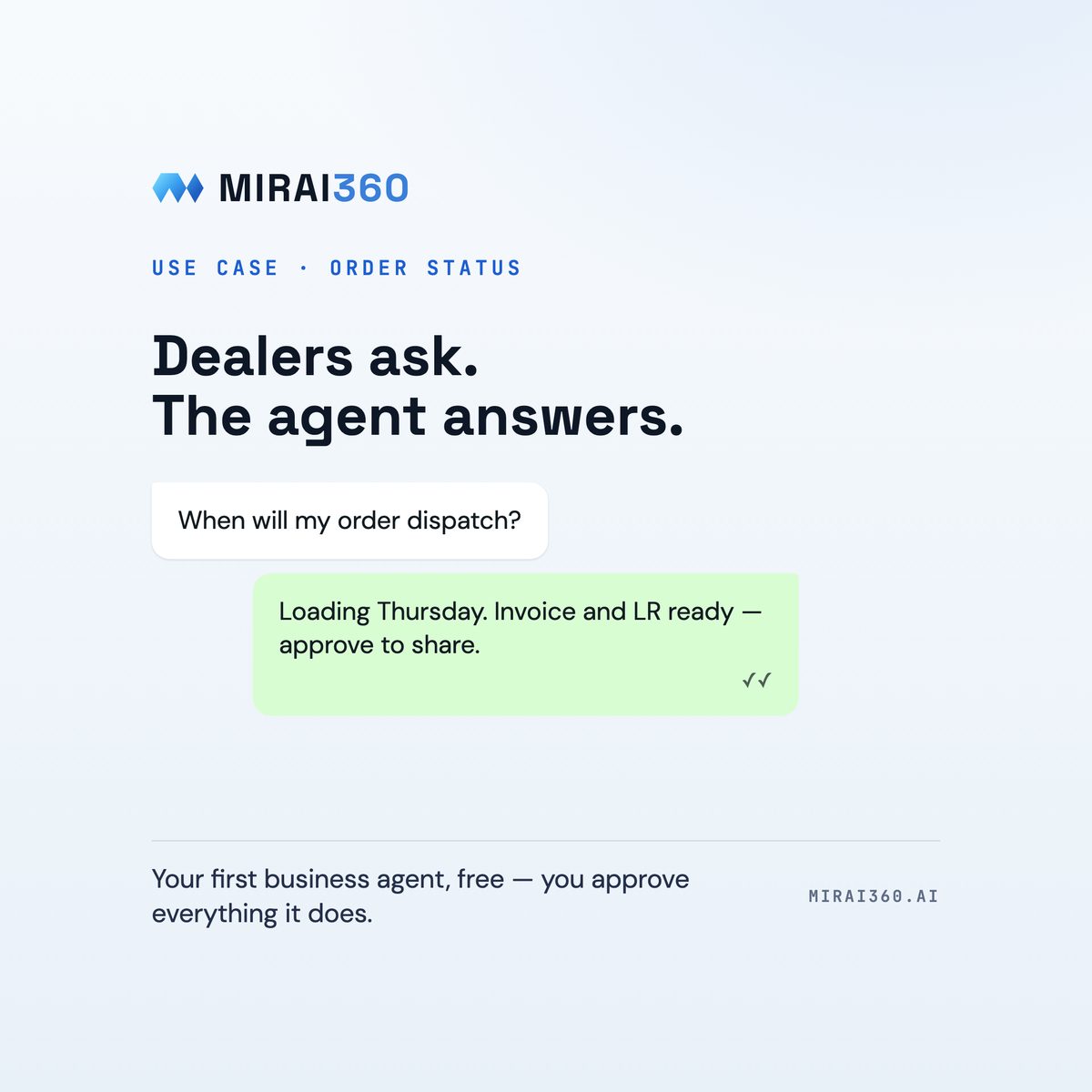
The same design applies to the question every business fields many times a day on WhatsApp: where is my order, and when will it arrive? Mirai360's order-status agent reads the order system, drafts a reply, and escalates anything unusual to a person, with a measured baseline and a full audit trail keeping the workflow accountable (full mechanism: AI Agent for Order-Status and Delivery Support). On WhatsApp specifically, that means a dealer's dispatch question gets an answer drafted from the business's own dispatch data, with a person approving it before it goes back.
Payment and quote follow-ups that don't depend on someone remembering
A quote sent and never chased simply expires — a quieter revenue leak than a lost order, because it leaves no record of failure. The same agent design applies here: it watches the list of open quotes or pending payments, sends a polite follow-up message at intervals the business sets, escalates to a person when the customer replies with a question, and marks each one resolved, overdue, or expired so the pipeline stays honest (full mechanism: AI Agents for Quotes and Follow-Ups). Run on WhatsApp, the channel a business's customers already reply on, that follow-up reaches them where they are, drafted by the agent and sent only after a person's review.
What does "a person approves everything" mean in practice?
Every draft this agent produces — a quote, a status update, a follow-up message — goes to a named person before it reaches a customer. Mirai360 builds the approval step into the workflow itself, not as an audit added afterward. The agent's job is the draft; the decision to send stays with a person who knows the account.
Worth a conversation?
We start with a free discovery call — we learn how your business runs, find the one problem worth solving, and recommend an agentic AI solution for it.
Message us on WhatsAppHow does Mirai360 apply its deployment discipline here?
The same discipline Mirai360 applies to every workflow, because the industry-wide failure pattern is the same one: Gartner expects over 40% of agentic AI projects to be cancelled by the end of 2027, citing escalating costs, unclear value, and weak controls (Gartner press release, 25 June 2025: gartner.com).
- Pick one workflow first. Photo-to-quote, order status, or follow-ups — not the whole conversation.
- Record a baseline before go-live. Current reply time and how many quotes go unchased, written down before the agent starts.
- Keep a person on every message. The agent drafts; a named person approves before it sends.
- Log everything. Every draft and approval sits in one audit trail.
- Scale against pre-agreed numbers. A second workflow, or wider authority, follows only when the recorded numbers support it.
What does a business need to start?
Access to the WhatsApp number the conversations already arrive on, the underlying data the agent should read from — a catalogue, an order system, a CRM — and a decision about who approves a message before it sends. No in-house data science team is required; the work on the business's side is describing the workflow and the data it already has.
How do you measure whether it is working?
Against the baseline recorded before go-live: reply time, the share of quotes that get chased instead of going quiet, and the share of conversations answered same-day. Review on a set schedule, and widen the agent's role only when the numbers support it.
Frequently asked questions
Is WhatsApp automation the same as a chatbot?
No. A chatbot answers general questions with scripted replies inside WhatsApp. This is an AI layer for the business that happens to talk through WhatsApp: it reads the business's own data — a catalogue, an order system, a CRM — and drafts a specific reply for a specific workflow, with a person approving it before it sends. WhatsApp is where the conversation happens; the reading and drafting are one system, not a bot living only inside the chat.
What WhatsApp workflows can an agent handle?
Three so far, each built as its own narrow agent: matching an inbound photo to a catalogue and drafting a quote, answering order-status and dispatch questions from real data, and following up on open quotes or pending payments at set intervals.
Will the agent ever send a message without approval?
No. Every draft — a quote, a status update, a follow-up — goes to a named person before it reaches the customer.
What does a business need before starting?
Access to the WhatsApp number in use, the underlying data the agent should read from, and a decision about who approves each message before it sends.
Talk to us
Mirai360 AI scopes this AI layer against a business's own data and baseline numbers before anything goes live — reached through WhatsApp, wherever the business already talks to its customers. We start with a free discovery call — we learn how your business runs, find the one problem worth solving, and recommend an agentic AI solution for it. DM us on Instagram (@mirai360ai) and we'll set it up.
FAQ
- Is WhatsApp automation the same as a chatbot?
- No. A chatbot answers general questions with scripted replies. This agent reads the business's own data — a catalogue, an order system, a CRM — and drafts a specific reply for a specific workflow, with a person approving it before it sends.
- What WhatsApp workflows can an agent handle?
- Three so far, each built as its own narrow agent: matching an inbound photo to a catalogue and drafting a quote, answering order-status and dispatch questions from real data, and following up on open quotes or pending payments at set intervals.
- Will the agent ever send a message without approval?
- No. Every draft — a quote, a status update, a follow-up — goes to a named person before it reaches the customer.
- What does a business need before starting?
- Access to the WhatsApp number in use, the underlying data the agent should read from, and a decision about who approves each message before it sends.